

How the warehouse packs a parcel, and the photos you can pay for
Once you submit, the parcel stops being yours for a while. Staff choose a box, pack in a set order, add filling, seal, reinforce, label, and weigh. PonyBuy publishes the standard they follow, with photographs, and almost nobody reads it.
It is worth reading because two of those steps change your bill and one of them changes what you can prove later.
The five published steps
This is the sequence in the PonyBuy Parcel Packing Standard, in its own order.

Select a suitable box and seal it
The box is chosen for the contents rather than the contents fitted to a standard box.
Pack in a particular order, with extra bubble sheet on top
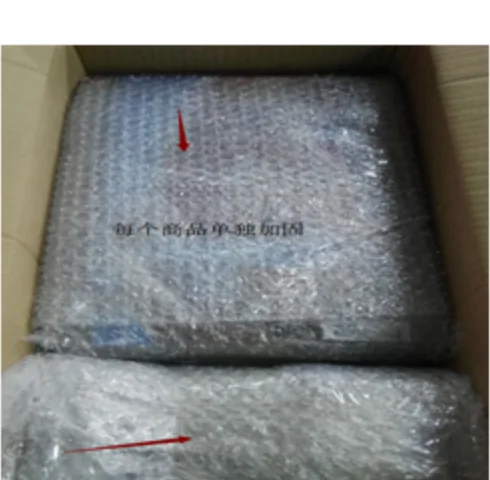
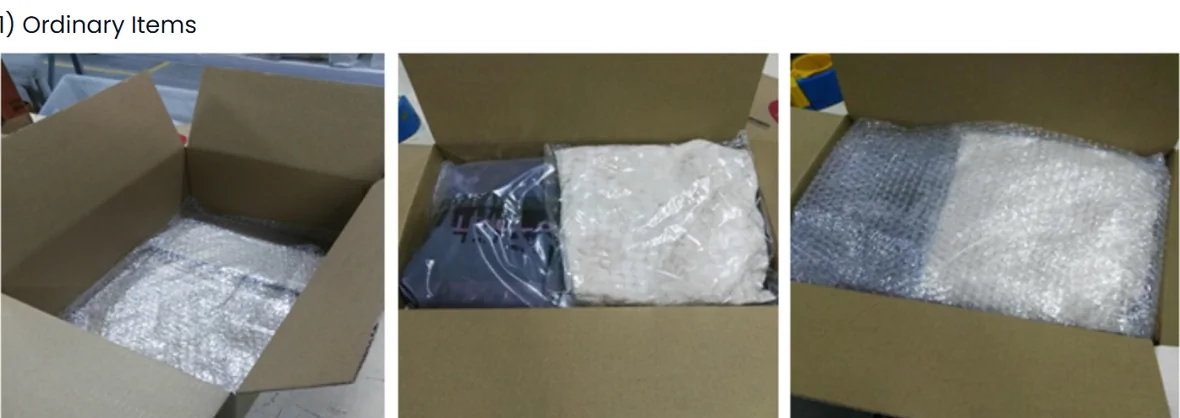
The standard splits into four groups, each photographed: ordinary items, food, fragile items, and irregular shapes. Fragile goods get thick bubble wrap and each piece wrapped on its own.
Seal and reinforce, then attach the shipping label
Reinforcement is part of the standard, not an extra you request.
Add a fragile note where it applies
Applied to parcels the warehouse has identified as fragile.
Customised logo service, if you have arranged one
You supply physical stickers to the warehouse and staff apply them. PonyBuy is explicit that any delivery, customs, infringement or other legal risk arising from that logo is yours.
The step that quietly decides your volumetric weight
Group four of the standard reads: irregular shape items, extra filling adding, cutting paper boxes to reduce volume. Cutting the carton down is listed as normal practice, not as a favour.
On a route that bills volumetric weight, height is one of three multiplied numbers. A shorter box is a smaller bill for exactly the same goods. This is also the reason a request to remove packaging cuts both ways: it lowers actual weight, and it makes the estimate you already paid a deposit against wrong.
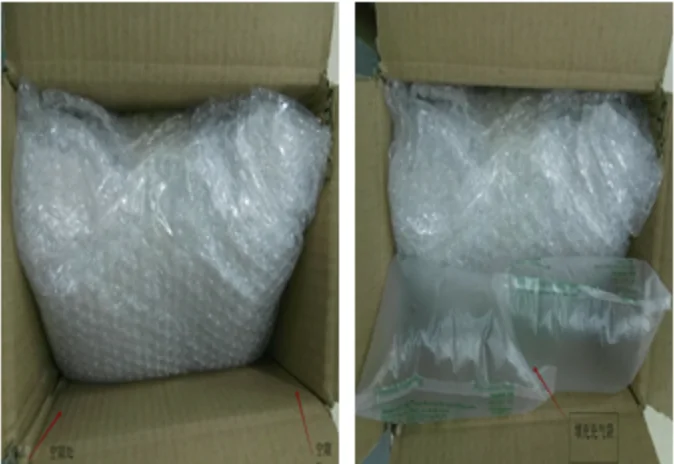
Fragile goods are wrapped individually, and that has a weight
The fragile group in the standard shows each piece rolled in thick bubble wrap before it goes in the box. Protection and weight are the same decision, and the warehouse resolves it in favour of protection.
If you are combining glass or ceramics with clothing, expect the packaging share of your billed weight to be higher than it was on a clothing-only parcel.
What QC is, and why it is a deadline rather than a picture
QC is forum shorthand. PonyBuy calls the same thing inspection in its help centre and Quality Check on its front page, and it happens once: when your item reaches the warehouse, before it joins anything else. Three photographs come out of it, and those photographs are what most people mean when they say QC.
Treating it as a picture is the mistake. It is a deadline. Up to that point your item is a single line in the warehouse, on its own, with its own order behind it and a merchant still reachable at the other end. After you submit a parcel order it is packed with everything else, and a problem with one shoe becomes a problem with the whole box.
That is the whole reason the inspection photographs arrive before the parcel stage rather than after it. The question to ask of them is not whether the item looks nice. It is whether you would still send this thing across the world knowing the postage is the same either way.
What inspection does and does not cover
Worth knowing before the parcel is sealed, because after that the evidence is whatever photographs exist.
Appearance, on arrival at the warehouse
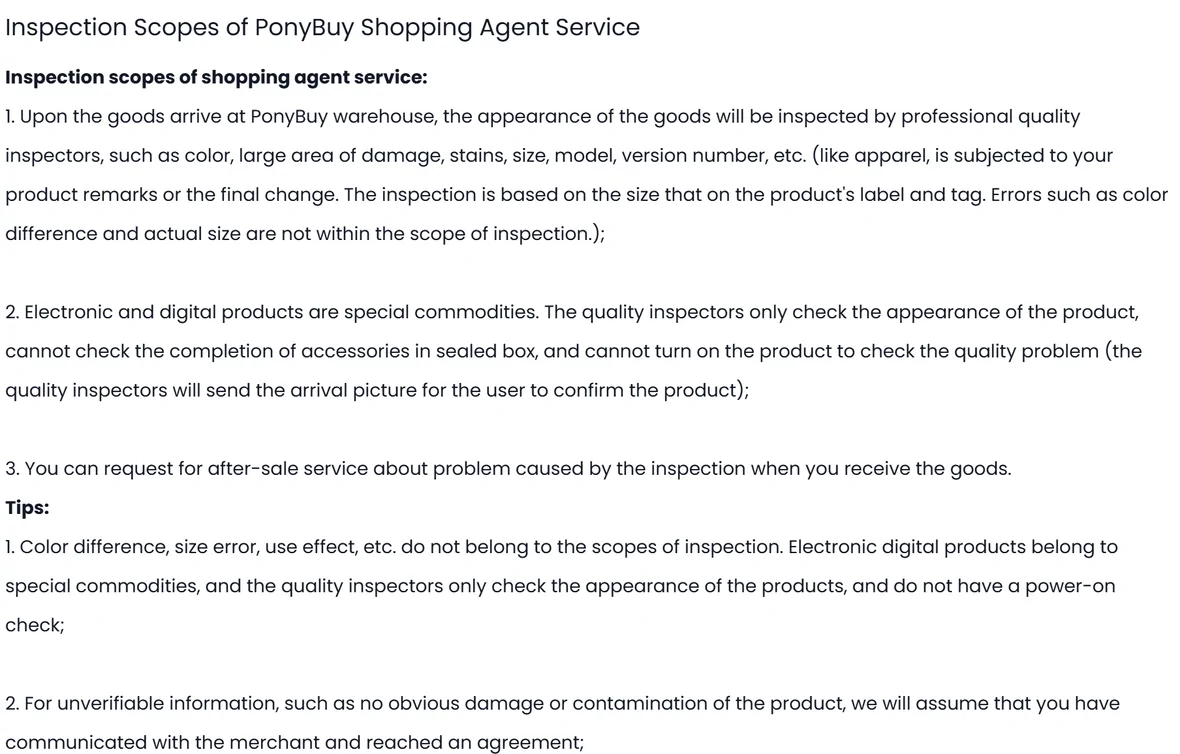
Colour, large areas of damage, stains, size, model and version number are checked by inspectors. For clothing, sizing is judged against the label and tag and against any remark you left on the order.
Colour difference, size tolerance, how it performs
PonyBuy lists these explicitly as outside the scope. If a shade is slightly off or a measurement is a centimetre out, that is not an inspection failure.
Anything inside a sealed electronics box
Electronics and digital products are checked for appearance only. Inspectors do not power devices on and cannot confirm the accessories inside a sealed box. They send the arrival picture for you to confirm.
Anything not visibly wrong
Where information cannot be verified, PonyBuy assumes you have already agreed the details with the merchant. That assumption is doing a lot of work, and it is the reason to be specific on the order rather than after it.
The photograph menu
Three photographs come with the inspection. Everything past that is priced per shot. Both kinds can be re-taken if they do not meet the standard you asked for.
| What | Who chooses the angle | Limit | Price |
|---|---|---|---|
| Standard inspection photos | The warehouse, by category standard | Three: front, back, and side or logo | Included |
| Detailed photo, requested with the order | You | Up to twenty per request | 1 RMB each |
| Detailed photo, requested after arrival | You, quoting the item number | Up to twenty per request | 1 RMB each |
| Parcel photo | The warehouse | One before sealing, one after | 5 RMB per parcel |
PonyBuy Detailed Photo and About Warehousing Value-Added Services, checked 2026-08-06. Original page.
How to read a QC set before you approve it
Three photographs, taken by someone who has never seen the listing you bought from, arrive in your account. Here is what they can settle and what they cannot, which is mostly a matter of knowing which column a given worry belongs in.
Questions the photographs can answer
- Is this the right item at all, rather than a different colourway or model
- Does the label agree with the size you ordered, and with the remark you left
- Is there visible damage, staining or a missing tag
- Does the version or model number match what you were promised
- Is anything obviously absent from what should be in the package
Questions they cannot, and asking louder will not help
- Whether the shade is exactly the one on your screen: colour difference is outside the stated scope
- Whether a measurement is within tolerance: small size variance is outside it too
- Whether it works: electronics are checked for appearance and not powered on
- What is inside a sealed box: inspectors confirm the outside and send you the arrival picture
- Whether the merchant was honest about anything you did not put on the order
Rehearsal packing is the one that pays for itself
For 20 RMB per parcel the warehouse packs your items as though it were shipping them, weighs the result, and tells you the number before you submit the parcel order. Notification comes by email and internal message.
Everything difficult about a haul comes from not knowing the final weight until after you have committed to a route. This service removes that. On a small parcel it is not worth it. On a ten item haul where you are choosing between two routes with different first weights, it is the cheapest thing on the menu.
